Legacy Summerville Concrete and MasonryLegacy Summerville Concrete and Masonry

Walkway construction in Summerville SC - a path that stays level and tight

Tired of muddy shortcuts or a cracked, heaving walk to the door? We build paver and concrete walkways on a firm base that stays put.

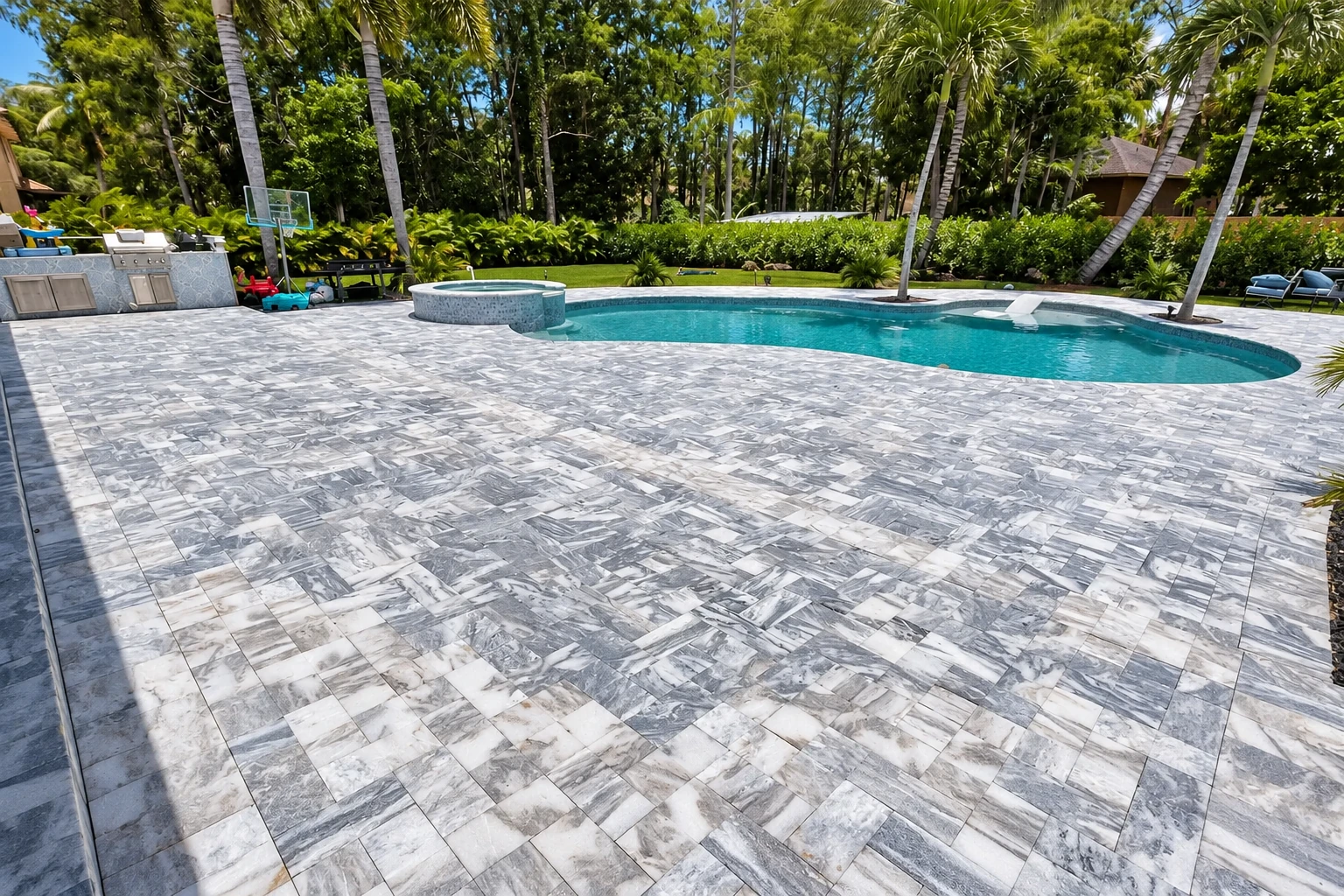
Large gray-and-white tiled walkway surrounding a backyard pool, with palm trees and outdoor kitchen in the background.

Walkway construction in Summerville, SC means building a paver or concrete path to your door on a packed, edged base, so it stays flat and sheds rain for years.

What does building a walkway in Summerville involve?

A paver walk is built in layers. We lay out the route first, dig it out, pack the soil and spread a compacted gravel base. Then we set an edge restraint, level a bed of sand and place the pavers. Each layer holds up the one above it, so a shortcut in the ground shows up later as a low spot or a loose paver.

The price moves with the length of the walk, the paver or concrete you pick, how much digging and base it needs, whether an old walk has to come out, and how many curves the route has. The schedule turns on the weather and on whether a permit, a historic district review or a tree permit has to come first. Your written estimate lists the materials, the steps and anything not included.

What makes a walkway hold up for years

A walkway looks simple, but most of what decides how it holds up sits under the surface or off to the side. These are the points I look at first.

Packed ground under the base

How well the soil is compacted under the pavers decides how they perform, and good compaction keeps settling to a minimum. If you're comparing quotes, ask each contractor how they compact the soil, because that answer tells you more about how the path will hold up than any paver catalog.

Room between trees and the walk

Large roots can lift a slab or a row of pavers, and fixing it means cutting roots, which can hurt the tree or leave it less steady in high winds. A good rule of thumb is to keep two sidewalk widths between a nearby tree and the edge of the path.

A slope that sheds rain

A walk has to send rainwater off to the side, not toward your house or into a puddle at the door. We set the grade so water runs to the lawn or a bed, because standing water on a walk stays slick and works its way down into the base.

Control joints on concrete

If you'd rather have a poured walk, it needs control joints, the shallow grooves cut across the slab at regular spacing. Concrete shrinks as it cures and cracks somewhere, so those grooves give it a straight, planned place to do it instead of a jagged line across the middle.

What happens when you call about a walkway in Summerville?

Here's how a walkway job runs with us, from your first call to the day we hand it back, and what you'll have in writing before any digging starts.

  1. 1

    Call or send the form

    Call us or use the form and tell us where the walk should start and end. We'll set a time for me to come out and see the route in person.

  2. 2

    Get a measured, written estimate

    I look the route over, measure it and ask what you want the walk to do. You get a written estimate with the materials, the steps and anything not included, and before we start I check with the office that covers your address about permits.

  3. 3

    Our crew builds the walk

    Our crew digs, compacts, sets the edge and lays the pavers, and I check the work as it goes. Summerville allows construction between 7 AM and 9 PM, so we keep our work days inside those hours.

  4. 4

    Walk it with us

    When it's done, we walk the finished path with you and leave the site clean. After that, keep an eye on the joint sand, since a low joint after hard rain is easy to top up before pavers start to shift.

Request an estimate

How we handle walkway construction

Before anything gets marked out, we walk the route with you. I want to see where people actually step, where the walk has to start and end, and how close the trees sit to it, because a path laid too near a big trunk is the one that ends up lifted. If a tree is in the way, we move the line or talk about the tree before we dig.

Once the line is settled, our crew digs it out and compacts the ground well, then builds and packs the base on top. That packing is the step I check hardest, since a soft spot under the base turns into a dip in the walk. Then we set a firm edge along the sides so the pavers stay tight against each other instead of creeping toward the grass.

A walk often meets other masonry. If it runs along a garden wall or a raised bed, we can plan it with brick wall installation so the two line up. If you want natural stone steps, a stone border or a landing at the door, our stone masonry work ties into the same base and layout.

Pavers or poured concrete

Pavers can be lifted and relaid if a section settles or a root pushes up, so I lean that way near trees. A poured walk is one piece with no joints to weed, and it relies on control joints to crack in straight lines.

Straight run or curved path

A straight walk is quicker to build and uses fewer cut pavers. A gentle curve can follow how people really walk and steer around a tree's roots, and it's worth the extra cuts when it keeps the walk from lifting later.

Get a written walkway estimate for your Summerville home

We get back to you within one business day to set a time for me to come out. The estimate is free, done on site and comes with no pressure to book. I measure the route, ask what you want the walk to do and write up the materials, the steps and anything not included, so you can compare it side by side.

(843) 376-1285

hi@summervilleconcreteandmasonry.com

Walkways, trees and permits in Summerville

Whether your walk needs a permit is something we check rather than guess. We find out if your address sits inside city limits or in the county, ask the office that covers it, and handle the permit and inspections when the job needs them. Inside the Town of Summerville, Historic District work needs Board of Architectural Review approval before you can apply for the permit, and we help you line up approvals like that one or an HOA's.

Trees shape the route here too. The city requires a permit to remove trees eight inches across at chest height, so if keeping the walk two sidewalk widths off a trunk would mean taking a tree out, that permit comes first. On new construction, the tree removal permit goes in with the building permit and gets reviewed with the site plan.

Most walks we build around here run from a driveway to the front door or out to a back patio, and plenty pass under a big tree. We're based in Summerville and work across the cities around it in Dorchester, Berkeley and Charleston counties, including Sangaree and Ladson, where the first question is which office covers your address.
Why Summerville homeowners call Legacy Summerville Concrete and Masonry for walkways

I learned brick, block and stone on a big commercial outfit where every course got measured and checked before the next one went on, and I started this business in Summerville in 2013 to work the same way on homes. That's 13 years of laying out walks, walls and patios, and I still come out to look at your job and measure it myself.

Our own crew does the work, and I check it as it goes, because a base that isn't packed or an edge that isn't straight is easy to fix before the pavers go down and hard to fix after. We're fully licensed and insured. Summerville requires contractors to hold the right South Carolina license for the work plus a business license from the city, so ask anyone you're comparing about both.

Satisfaction guaranteed on every job. When you're ready to plan the walk, call (843) 376-1285 or send us the form and tell us where it should start, where it should end and what it has to pass on the way.

Brick wall installation

A low brick wall along the walk can hold back a planting bed or mark the edge of the yard, and it gives the path a finished border.

Stone masonry

Natural stone suits steps up to a porch, a landing at the door or a border where the walk meets the garden, built on the same careful base.

Where we build walkways around Summerville

Below are the cities around Summerville that have their own page on our site. They aren't the only places we go, so if your street sits between them, give us a call.

Walkway questions we hear from Summerville homeowners

How much does it cost to build a walkway in Summerville, SC?

We price each walkway after I measure it on site, because the length, width and material set most of the cost. An old walk to tear out, tree work or a long run of cut pavers on curves adds to it, while a straight run in pavers or plain concrete keeps it down.

How long does a concrete walkway last?

A Canadian research council puts the average life of a concrete walk at 20 to 40 years, and it names build quality as the main thing that decides where a walk lands in that range. That's why we spend the time on the base, the joints and the slope instead of rushing to the pour.

Why does edging matter on a paver walkway?

The edge is what keeps the pavers pressed against each other, and without a strong one they drift apart and the joints open up. Paver guidance rules out flat metal or plastic landscape edging, the kind around flower beds, because it can't hold pavers tight, so we plan a sturdier edge restraint from the start.

How long does it take to build a paver walkway in Summerville?

There's no set number, because time on site depends on the walk's length, how much digging and base it needs and the weather while the crew works. If the job needs a permit, a historic district approval or a tree removal permit, that comes first, so we sort it out before we schedule the crew.

What should I do to get my yard ready for a new walkway?

Clear pots, furniture and anything else off the route, and tell us where sprinkler heads, low-voltage lights or pet fences run so we can work around them. If you know of buried pipes or lines near the path, point them out when I come out, since the route gets settled before anyone digs.

Call or send photos of your route

Call (843) 376-1285 or send the form with your address, a rough path length and photos of any nearby trees, so I come out already knowing what to measure.

(843) 376-1285Request an estimate